AC Dimmer Controller, 4 Channels, AC + ESP8266
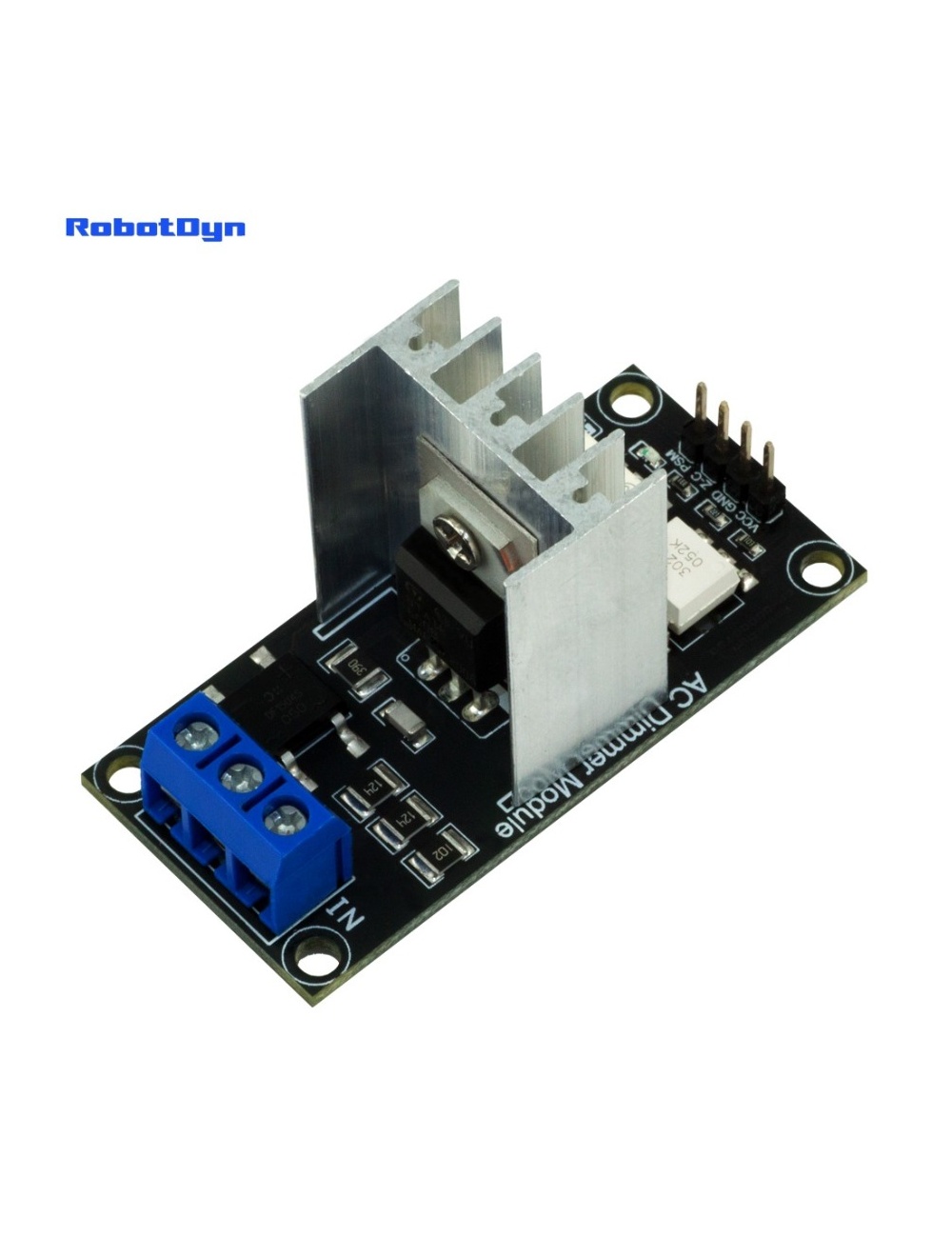
Overview
The RobotDyn 4-Channel AC Dimmer with ESP8266 is a complete WiFi-controlled multi-zone AC dimmer. Four independent TRIAC channels, one shared zero-cross detector, and an onboard ESP8266 — perfect for whole-room lighting scenes, RGB-style multi-bulb effects, or multi-zone heater/fan control.
This is the most-capable single-board dimmer in the RobotDyn lineup. Combined with Tasmota or ESPHome, it integrates directly with Home Assistant, Alexa, Google Home, or any MQTT broker.
Architecture
┌──────────────────────────────────────┐
│  ESP8266EX (WiFi + dimming logic)    │
│      │ GPIO4 GPIO5 GPIO12 GPIO13     │
│      └─────────────────────────┐     │
│        ┌──── Zero-cross ───┐   │     │
│        │                   │   │     │
│    4× Optocoupler ─────────┤   │     │
│        │                   │   │     │
│    4× BTA16 TRIAC ─────────┘   │     │
│        │ │ │ │                 │     │
│  AC out 1 2 3 4    AC in (mains)     │
└──────────────────────────────────────┘
Each channel has its own optocoupler-isolated TRIAC, so a fault on one channel doesn’t damage the others or the ESP8266.
Common Uses
- Whole-room lighting scenes — 4 lamps each dimmable independently, controlled from one HA dashboard
- Multi-zone heating — 4 heating elements (e.g. greenhouse zones) with independent PID control
- Stage / event lighting — left/right/front/back banks with smooth transitions
- Reflow oven controllers — top, bottom, sides each with their own PID loop
- Multi-channel fan controllers — exhaust, intake, circulation, etc.
Tasmota Setup
Same flashing process as the 1-channel ESP8266 dimmer — connect USB-TTL, hold Flash button, esptool, configure WiFi.
Tasmota template with 4 channels enabled:
{"NAME":"RobotDyn 4ch Dimmer","GPIO":[0,0,0,0,409,408,0,0,407,406,405,0,404],"FLAG":0,"BASE":18}This gives you 4 independent dimmer entities in the Tasmota web UI, each with 0–100% brightness slider.
ESPHome Configuration
esphome:
  name: dimmer-livingroom
  platform: ESP8266
  board: esp01_1m

wifi:
  ssid: "YourWiFi"
  password: "YourPassword"

api:
ota:

light:
  - platform: monochromatic
    name: "Lamp 1"
    output: ch1
  - platform: monochromatic
    name: "Lamp 2"
    output: ch2
  - platform: monochromatic
    name: "Lamp 3"
    output: ch3
  - platform: monochromatic
    name: "Lamp 4"
    output: ch4

output:
  - { platform: ac_dimmer, id: ch1, gate_pin: GPIO4,  zero_cross_pin: { number: GPIO5, inverted: yes } }
  - { platform: ac_dimmer, id: ch2, gate_pin: GPIO12, zero_cross_pin: { number: GPIO5, inverted: yes } }
  - { platform: ac_dimmer, id: ch3, gate_pin: GPIO13, zero_cross_pin: { number: GPIO5, inverted: yes } }
  - { platform: ac_dimmer, id: ch4, gate_pin: GPIO14, zero_cross_pin: { number: GPIO5, inverted: yes } }
All 4 channels share the same zero-cross interrupt pin — that’s correct, they all switch on the same AC waveform.
Power Considerations
- Per channel: 4A continuous (per BTA16-600B spec), 8A with heatsink
- Total board: limited by PCB trace width and AC connector — keep total combined load under 16A for safe operation
- Heatsink: essential for loads above 4A per channel — TRIACs dissipate significant heat in phase-cut mode
Safety Notes
Four channels = four times the AC wiring to get right. Be especially careful:
- Fuse each channel separately — if one shorts, only that fuse blows
- Use one continuous earth ground for the enclosure
- Keep AC wiring physically separated from logic-side wiring inside the enclosure
- For total loads above 10A combined, consider using two separate 4-channel modules instead of pushing one to its limit
Related Products
- 1-Channel AC Dimmer + ESP8266 — single-channel version
- AC Light Dimmer 2-Channel — 2 channels, needs external MCU
- ESP-01 SSR Relay — single-channel WiFi on/off (no dimming)
Where to Buy in 2026
RobotDyn discontinued. Look for 4-channel ESP8266-based dimmers on AliExpress — verify in the photos that you see 4 separate TRIACs and 4 separate optocouplers on the PCB. Cheap knockoffs sometimes shortcut to fewer components.