AC Light Dimmer Module, 2 Channel, 3.3V/5V logic, AC 50/60hz, 220V/110V
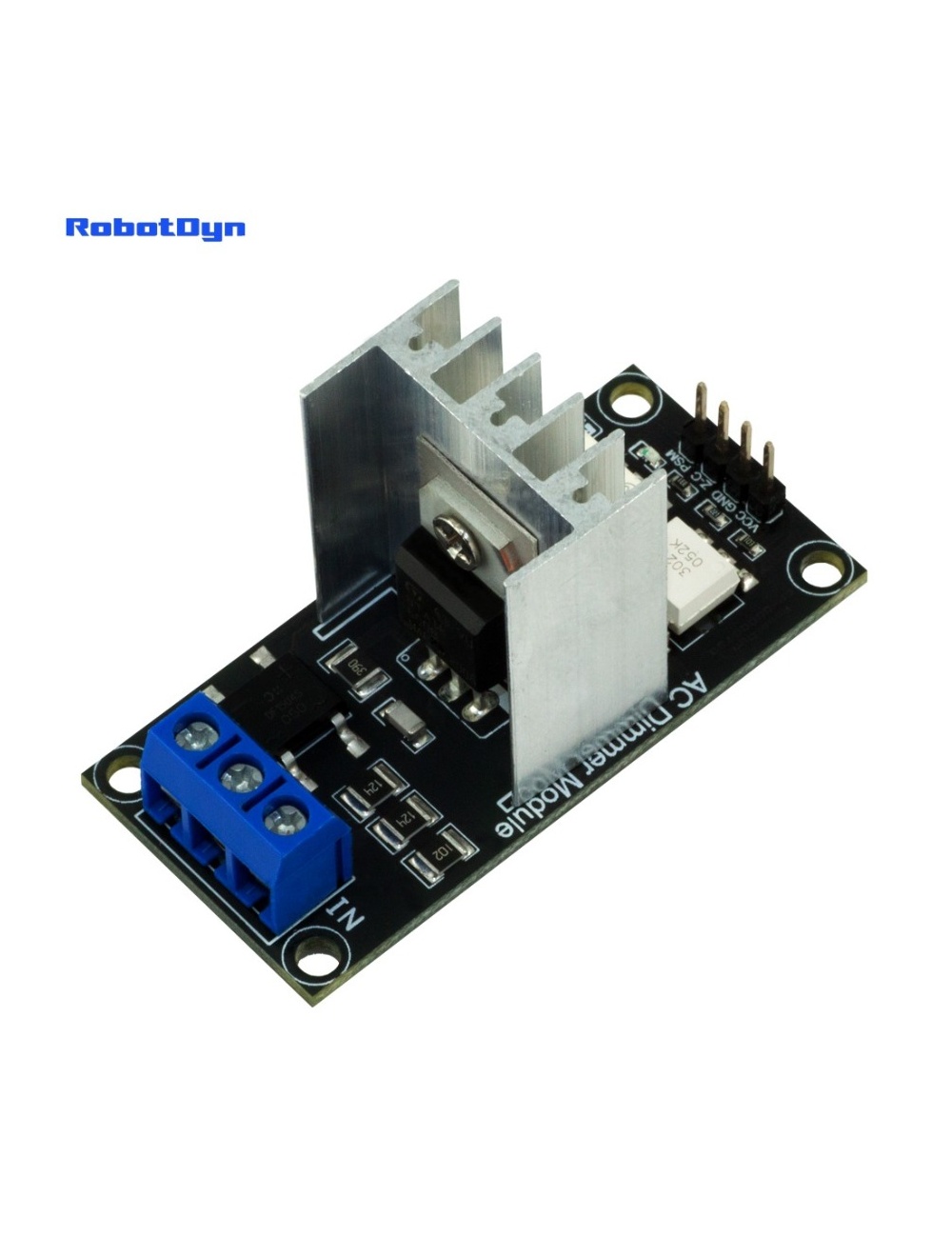
Overview
The RobotDyn 2-Channel AC Light Dimmer is the dual version of the popular 1-channel module — same proven TRIAC + optocoupler topology, but with two independent dimming channels sharing a single zero-cross detector.
Each channel can drive its own AC load with its own brightness level, controlled by separate PSM pins on your microcontroller.
Why Two Channels?
The most common reason: you want to control two lamps from one Arduino, or a fan + a lamp independently. Compared to using two 1-channel modules:
- Half the PCB footprint
- Single power supply for the logic side
- One ZC interrupt instead of two (saves microcontroller IO + interrupt pins)
- Cheaper than two boards
The single shared ZC pin is exactly the right design: both channels switch on the same AC waveform, so they only need one zero-crossing reference.
Pinout
| Pin | Function | Connect To |
|---|---|---|
| VCC | Logic supply | 3.3V or 5V |
| GND | Ground | GND |
| ZC | Zero-cross detection (shared) | Digital input with interrupt support |
| PSM1 | Channel 1 TRIAC gate | Any digital output |
| PSM2 | Channel 2 TRIAC gate | Any digital output |
Arduino Code Example
The RBDdimmer library supports multiple dimmer instances natively:
#include <RBDdimmer.h>

dimmerLamp dimmer1(3);   // PSM1
dimmerLamp dimmer2(4);   // PSM2

void setup() {
  dimmer1.begin(NORMAL_MODE, ON);
  dimmer2.begin(NORMAL_MODE, ON);
}

void loop() {
  dimmer1.setPower(75);   // channel 1: 75% brightness
  dimmer2.setPower(40);   // channel 2: 40% brightness
  delay(1000);
}
Both channels share the same ZC interrupt (pin D2 on Uno/Mega, D7 on Leonardo) — the library handles routing internally.
Common Uses
- Smart lamp + fan controllers (bedroom: lamp on PSM1, ceiling fan on PSM2)
- Two-zone lighting (warm + cool incandescents)
- Stage lighting controllers (left + right banks)
- Dual heating element controllers (e.g. reflow oven top + bottom)
- Dual AC motor speed controllers
Safety Notes
Same as the 1-channel version — this module switches mains voltage and requires proper enclosure, fusing, and clearance. Each channel needs its own load fuse.
For loads above 4A per channel, install separate heatsinks for each TRIAC (the two channels generate heat independently).
Related Products
- AC Light Dimmer 1-Channel — single-channel version
- 4-Channel AC Dimmer with ESP8266 — 4 channels with built-in WiFi
Where to Buy in 2026
RobotDyn discontinued, but 2-channel modules based on the same design are available on AliExpress and Amazon. Look for two BTA16-600B TRIACs and two optocouplers on the PCB before buying — cheap clones sometimes have only one optocoupler shared between channels (no real isolation).