Pro Mini ATmega328P (3.3V/8MHz or 5V/16MHz)
Overview
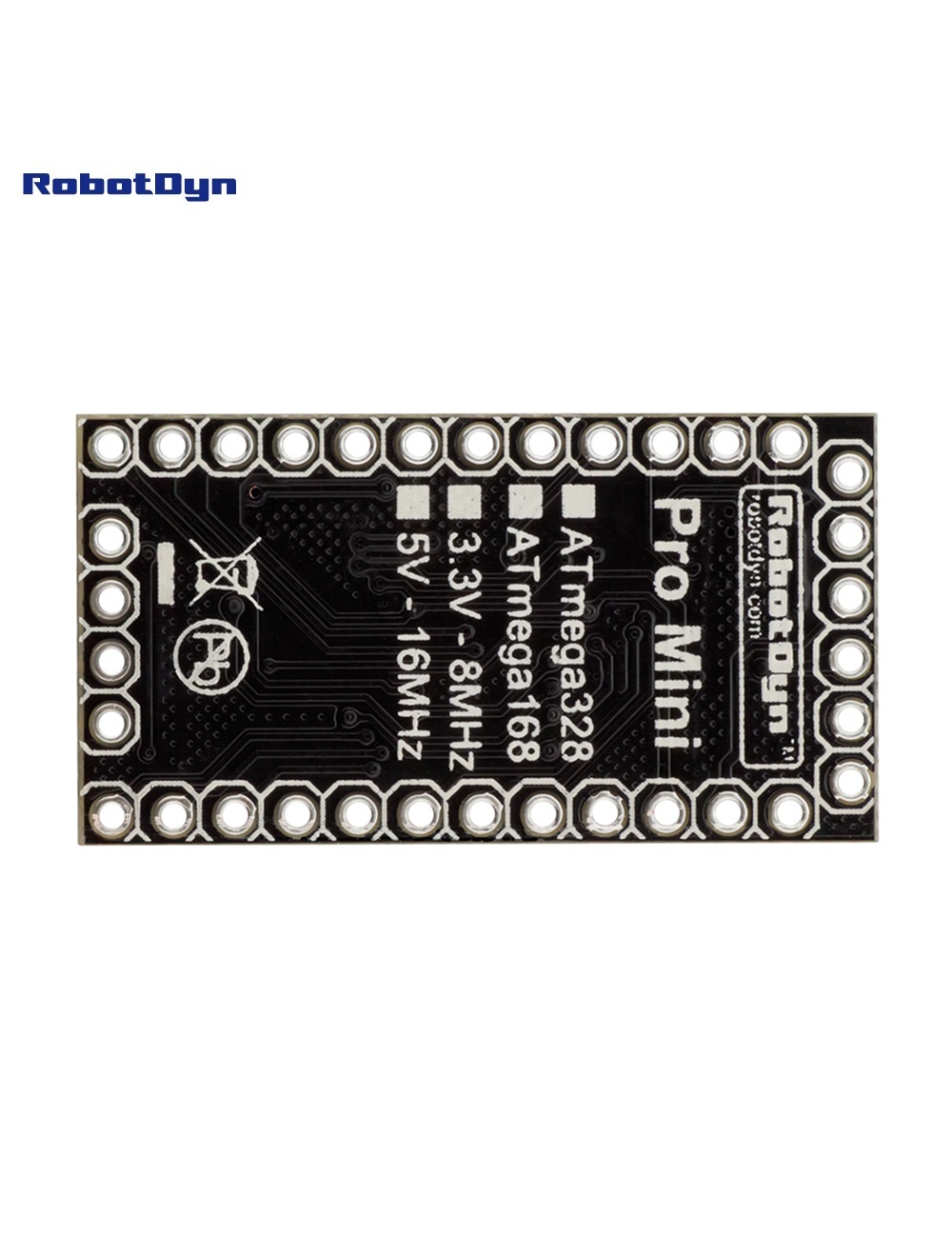
The RobotDyn Pro Mini is the smallest mainstream Arduino-compatible board — even more compact than the Nano. It uses the same ATmega328P MCU but removes the USB chip, voltage regulator, and physical connectors, leaving you with just the microcontroller and its essential support components.
This makes it ideal for battery-powered or permanent embedded projects where the USB hardware would be a waste of space and power.
Two Variants — Which to Choose?
5 V / 16 MHz (most common)
- Compatible with the vast majority of 5V Arduino sensors and shields
- Faster (16 MHz, same speed as Uno/Nano)
- Higher current draw — not ideal for battery projects
3.3 V / 8 MHz
- Lower power consumption (3.3V × 8MHz vs. 5V × 16MHz)
- Battery-friendly — runs directly from 2× AA cells via boost converter, or a single Li-Po (3.7V)
- Compatible with 3.3V sensors without level shifting
- Slower clock — some timing-critical libraries may not work without recalibration
For battery projects: 3.3V / 8MHz. For everything else: 5V / 16MHz.
Programming
There’s no onboard USB — you need an external USB-TTL converter (FTDI, CP2102, CH340G all work):
| FTDI/CH340 Adapter | Pro Mini Header |
|---|---|
| GND | GND |
| CTS | CTS (often grounded internally) |
| VCC (5V or 3.3V) | VCC |
| TX | RXI |
| RX | TXO |
| DTR | DTR |
The DTR line is critical — it auto-resets the Pro Mini at upload time. Without it, you’d have to manually press the reset button at the exact moment the IDE starts uploading.
In Arduino IDE:
- Tools → Board → Arduino Pro or Pro Mini
- Tools → Processor → ATmega328P (5V, 16MHz) or ATmega328P (3.3V, 8MHz)
- Select port and upload
Power Consumption (3.3V/8MHz variant)
| Mode | Current |
|---|---|
| Active (running sketch) | ~5–10 mA |
| Power-down sleep | ~0.1 µA |
| Active with onboard LED on | ~12 mA |
For long-running battery projects, desolder the power LED — it alone draws ~5 mA continuously (more than the MCU itself in sleep mode). Combined with sleep mode, a 3.3V Pro Mini can run months on a CR2032 coin cell for low-duty-cycle applications.
Common Uses
- Battery-powered sensor nodes (with LoRa, RF24, or BLE module)
- Wearables (tiny size)
- Permanent installations (no need for USB after deployment)
- “Smart” jewelry, badges, props
- Robotics where size matters more than features
Related Products
- Nano V3 CH340 — same MCU with onboard USB
- Micro ATmega32U4 — native USB HID support
Documentation
- Pinout PDF — coming soon
- FTDI wiring diagram — coming soon
- Battery operation guide — coming soon